

Safeguard on social
Every post we have published on our social profiles, newest first, with the copy exactly as posted. Each card links to the original post.
Posts on LinkedIn
RSS feed LinkedIn
Most security tools stall after the first enthusiastic team. The blocker is rarely scanning. It is identity and control. Our new post is the rollout guide for the platform owner and the identity architect: SAML 2.0, OpenID Connect or Google, Microsoft and GitHub sign-in, SCIM 2.…
Read the full postHide the full post
Most security tools stall after the first enthusiastic team. The blocker is rarely scanning. It is identity and control. Our new post is the rollout guide for the platform owner and the identity architect: SAML 2.0, OpenID Connect or Google, Microsoft and GitHub sign-in, SCIM 2.0 provisioning, passkey and TOTP multi-factor, built-in and custom roles, a tenant and organization hierarchy, and an append-only audit log you can stream to your SIEM. It also gives a phased plan: pilot one team, put SSO, multi-factor and roles in first, run policies in Warn or Notify, then switch the gates that matter to Block. What to do today: draw your tree. One organization per business unit, a separate one for any group that must be hidden from the rest, and a product for each release train. Roles and policies attach to that structure, so decide it before anyone configures SSO. Read it here: https://lnkd.in/g8gQVDZZ #AppSec #SSO #DevSecOps
 LinkedInVideo
Anyone, or any token, that can push a workflow file to a repository can read every secret that repository can see. A campaign researchers call Gheist is built on exactly that. Per research published on 25 October, stolen GitHub tokens are used to push a ci-sync branch with one w…
Read the full postHide the full post
Anyone, or any token, that can push a workflow file to a repository can read every secret that repository can see. A campaign researchers call Gheist is built on exactly that. Per research published on 25 October, stolen GitHub tokens are used to push a ci-sync branch with one workflow file, sync-check. The push starts it, the job prints the secrets context into the Actions log encoded (so log masking misses it), and the run is deleted. Researchers count more than 13,500 planted branches across more than 850 accounts, and said the campaign was still active as of 24 October. GitHub's approval hold, announced 28 July, covers public repositories on https://lnkd.in/gumQgVic. It does not cover private repositories or GitHub Enterprise Server. What to check today: 1. Search every repo for branches matching ci-sync-xxxxxx, and look for runs deleted within a minute. 2. Review who and what can change workflow files. Most automation does not need to. 3. Check token scope and lifetime. Short-lived beats a classic token that never expires. 4. Put production secrets behind environments with required reviewers, and scope cloud trust to that environment. There is no CVE and nothing to patch. Indicators and exact commands: https://lnkd.in/gVdKqZka #GitHubActions #DevSecOps #CICD
- LinkedIn
Where does your source code go when you buy a security platform? For regulated buyers that question comes before any feature demo. So we wrote the answer deployment by deployment. The new post covers SaaS in the US, EU (Frankfurt, Germany) and Gov regions, a single-tenant privat…
Read the full postHide the full post
Where does your source code go when you buy a security platform? For regulated buyers that question comes before any feature demo. So we wrote the answer deployment by deployment. The new post covers SaaS in the US, EU (Frankfurt, Germany) and Gov regions, a single-tenant private VPC, fully on-prem, and air-gapped with models running offline. It also covers the local runner, which scans on your machine and sends back only the SBOM and findings, never source code. The AI mode (Full AI, Zero AI, bring your own model, local models) is a separate choice from hosting, so "no LLM anywhere" is possible even on SaaS. What to do today: list your data classes (source, manifests, SBOMs, findings, container images) and mark which ones may leave your network. That table decides your deployment model, and the post gives you a version you can paste into a questionnaire. Read it here: https://lnkd.in/gdNt5C7R #SupplyChainSecurity #DataResidency #CISO
 LinkedInVideo
28 October: Node 26 moves to LTS, and Node 27 starts its Alpha phase. A good day to check which Node line every service actually runs. From the Node Release working group schedule: Node 20 reached end of life on 30 April 2026. Node 22 ends on 30 April 2027. Node 24 ends on 30 Ap…
Read the full postHide the full post
28 October: Node 26 moves to LTS, and Node 27 starts its Alpha phase. A good day to check which Node line every service actually runs. From the Node Release working group schedule: Node 20 reached end of life on 30 April 2026. Node 22 ends on 30 April 2027. Node 24 ends on 30 April 2028. Node 26 ends on 30 April 2029. The 21 October 2026 security release covered 26.x, 24.x and 22.x. If a service sits on a line outside that list, it did not get those fixes. Two steps for platform and AppSec leads: list every service with its Node version, then find every place that version lives, base images, CI runners, serverless runtimes and build agents. Safeguard's SBOM lookup shows where a component and version sits across your estate. Our Node release history covers the io fork and merge, every LTS line, the permission model and how security releases ship: https://lnkd.in/gB_9pvXU Dates as of 26 Oct 2026, from the Node Release working group and https://lnkd.in/gHYhyD4F. #NodeJS #AppSec #DevSecOps
 LinkedIn
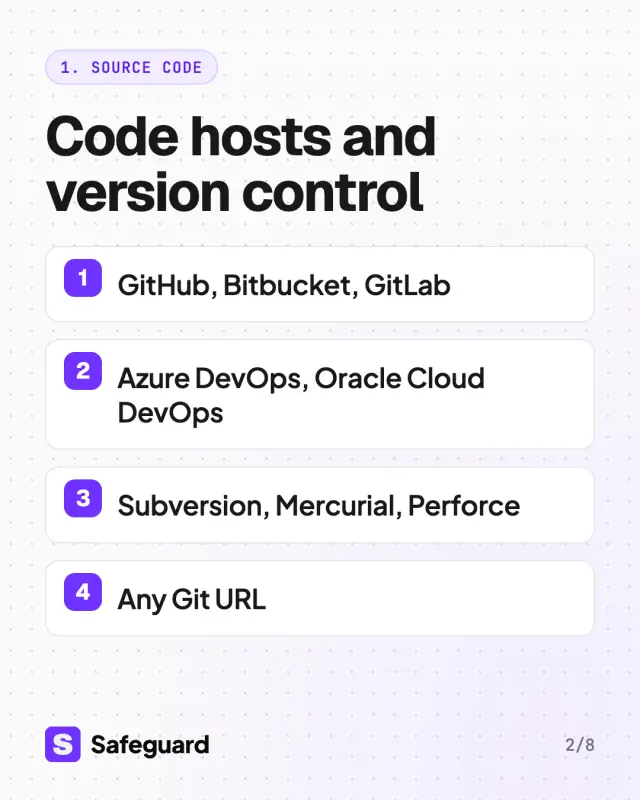
Most teams connect their code host, run a scan and stop. The images already in the registry, the models in a cloud AI account and the SBOM a supplier sent last quarter never get connected. Coverage is exactly as wide as the sources you add. Swipe for the map of every card on Saf…
Read the full postHide the full post
Most teams connect their code host, run a scan and stop. The images already in the registry, the models in a cloud AI account and the SBOM a supplier sent last quarter never get connected. Coverage is exactly as wide as the sources you add. Swipe for the map of every card on Safeguard's Integrations page, grouped the way the page groups them: Source code: hosted Git platforms, Subversion, Mercurial, Perforce and any Git URL. Images: cloud and self-hosted registries, Podman, Apptainer SIF and WebAssembly. AI: model hubs, cloud AI platforms, audit activity and OTLP from AI coding tools. Uploads: app binaries, manifests, SBOMs, CSAF/VEX and database change logs. Posture and testing: Package Firewall, DAST, IAST, API security, IaC, Kubernetes, cloud and database posture, Red Team, OSINT and VAPT from the CLI. Every card on the page is generally available, and every finding lands in the same Block, Warn or Notify gates. The rollout order we suggest: one code host with its CI route on Warn, then your production image registry, then Package Firewall in audit mode, then move what matters to Block. The full hub, with each card and what Safeguard does not do: https://lnkd.in/ggvYhzfj #AppSec #SupplyChainSecurity #DevSecOps
 LinkedInVideo
A verified name in the MCP Registry proves who published the record. It does not prove who runs the endpoint, or that the server is safe. Safeguard's MCP server is now in the official MCP Registry as http://sh.safeguard/safeguard. So here is how to check us, or any vendor, befor…
Read the full postHide the full post
A verified name in the MCP Registry proves who published the record. It does not prove who runs the endpoint, or that the server is safe. Safeguard's MCP server is now in the official MCP Registry as http://sh.safeguard/safeguard. So here is how to check us, or any vendor, before an assistant gets access. The registry checks one thing at publish time: that the publisher controls the namespace. It does not verify the remote URL and it does not scan server code. Its own moderation policy says to assume minimal to no moderation. Four checks before you approve a connection: 1. Pick by name, not title. The title is free text that anyone can set. 2. Reverse the namespace. http://sh.safeguard reads https://lnkd.in/gt8u9BUM, the domain the publisher proved. 3. Match the remote URL to the vendor's own docs, and confirm its host sits on that domain. 4. Safeguard is a hosted server with no package. If a guide asks you to install one for a hosted server, stop. Then connect. In Claude, add Safeguard from the connector directory and read the sign-in page before you click Authorize access. A new Safeguard workspace starts with a small set of read-only tools. Everything else stays off until an administrator turns it on. The full walkthrough, with every command and its output, is in the first comment. #MCP #AppSec #AISecurity #SupplyChainSecurity
 LinkedIn
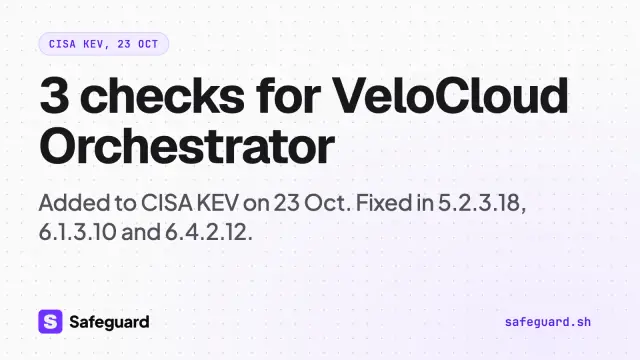
CVE-2026-114625, a SQL injection in on-prem Arista VeloCloud Orchestrator, went into CISA's Known Exploited Vulnerabilities catalog on 23 October. Arista says it is known to be actively exploited, and that any authenticated user, down to the Enterprise Read Only role, can act as…
Read the full postHide the full post
CVE-2026-114625, a SQL injection in on-prem Arista VeloCloud Orchestrator, went into CISA's Known Exploited Vulnerabilities catalog on 23 October. Arista says it is known to be actively exploited, and that any authenticated user, down to the Enterprise Read Only role, can act as the local superuser operator. Three checks to run today: 1. Do you run your own orchestrator? Arista has already patched Hosted and Dedicated VCO. The work is for on-prem installs. 2. Is your build fixed? The fixed releases are 5.2.3.18, 6.1.3.10 and 6.4.2.12, and later. Builds that fixed the earlier VCO flaws sit inside the affected ranges. 3. Who can reach the portal? Limit the web portal to admin networks, block the two source IP addresses in Arista's advisory, and review web access logs for the patterns it lists. Safeguard does not scan the appliance itself, so this starts as an inventory question: do you know which orchestrator versions you run, and who owns them? Full write-up with the version table and Arista's indicators: https://lnkd.in/grm4cDGH Sources: CISA KEV entry added 23 October 2026 (federal due date 26 October); Arista Security Advisory 0199. #VeloCloud #CISAKEV #NetworkSecurity #VulnerabilityManagement
 LinkedInVideo
A person holds about four things in mind at once. Some AI models now hold a million tokens, word for word. So the worry becomes memory. That is the wrong worry. A model has no hard line between instructions and data. Your system prompt, your request, a retrieved web page and a t…
Read the full postHide the full post
A person holds about four things in mind at once. Some AI models now hold a million tokens, word for word. So the worry becomes memory. That is the wrong worry. A model has no hard line between instructions and data. Your system prompt, your request, a retrieved web page and a tool result all arrive as tokens in one channel, and any of them can steer what an agent does next. That is prompt injection. A bigger window just gives it more room. What helps is structural, not clever prompting. Know every source that writes into an agent's context and who controls it. Then keep the agent's tools narrow: an agent that reads untrusted content should not send email or push code without a person approving it. We wrote the long version, with the research behind each point (Cowan on working memory, the "lost in the middle" results, OWASP's LLM01) and where Safeguard's AI-BOM discovery, MCP Guardrail and AI Gateway fit. Link in the first comment. #AISecurity #PromptInjection #LLMSecurity #AppSec
 LinkedInVideo
Your first big customer sends over the security review. One line on it decides the deal: SOC 2 Type II report. For a five person startup, the tooling alone is a real line item. Established compliance automation starts around $4,000 to $15,000 a year. Ours is $1,699 a year, flat,…
Read the full postHide the full post
Your first big customer sends over the security review. One line on it decides the deal: SOC 2 Type II report. For a five person startup, the tooling alone is a real line item. Established compliance automation starts around $4,000 to $15,000 a year. Ours is $1,699 a year, flat, for startups under 10 people. That is the lowest credible SOC 2 Type II automation price for a team that size. What it covers: Controls, evidence and tests sit in one place in Safeguard. Tests and evidence collection run on a schedule, so evidence builds up while you ship instead of in a scramble before the audit window. The same plan also covers your application security and your software supply chain. One subscription, not a compliance tool plus a separate security tool. Two things to be plain about. Audit fees are separate. The CPA firm's attestation is not part of the $1,699. If you want help there, we can coordinate the audit with an independent, accredited auditor, quoted per engagement. The rate is for startups under 10 people. Past that, standard pricing applies. Pricing is public: https://lnkd.in/giUMQeAJ #SOC2 #StartupSecurity #Compliance #AppSec
 LinkedIn
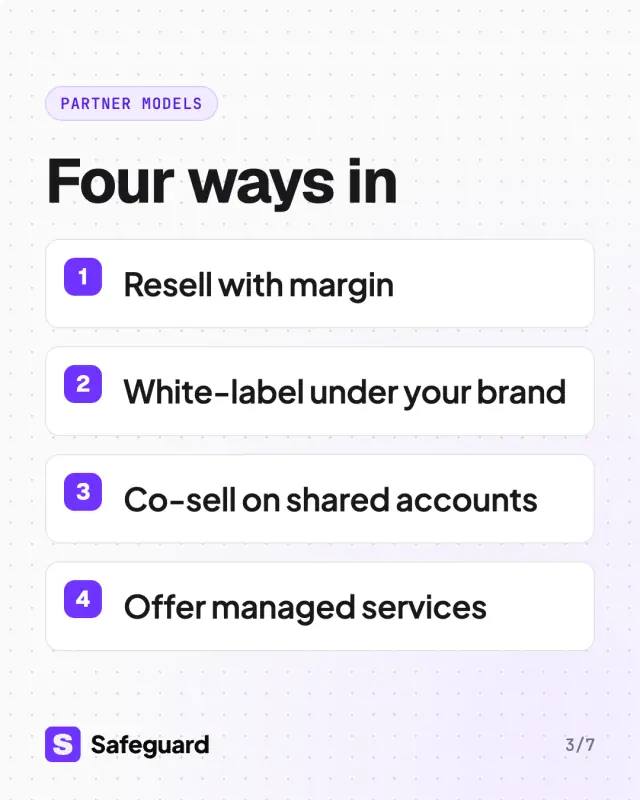
Safeguard's partner program is open worldwide. Partners get a 30% margin in year one, and 35% on deals registered with us. Four ways to work with us: 1. Resell with margin. Local resellers and distributors sell in their own currency and language, with in-region support. 2. White…
Read the full postHide the full post
Safeguard's partner program is open worldwide. Partners get a 30% margin in year one, and 35% on deals registered with us. Four ways to work with us: 1. Resell with margin. Local resellers and distributors sell in their own currency and language, with in-region support. 2. White-label. Run Safeguard under your own brand and own the customer. We power detection, remediation and evidence underneath. 3. Co-sell. Deal registration, named account alignment and joint pursuit support. 4. Managed services. MSSPs and managed security teams offer Safeguard as part of a broader service. It suits partners with in-market credibility and technical depth. Program details and how to apply: https://lnkd.in/gyQpJXK8 #PartnerProgram #MSSP #Cybersecurity #ChannelPartners
 LinkedInVideo
A Zero Day has no CVE. So a scanner that only matches public feeds has nothing to match. There is no advisory and usually no fix. CISA's KEV catalog can't list it either, because KEV needs a CVE ID first. Waiting on the feed is the one plan that cannot work here. What works is a…
Read the full postHide the full post
A Zero Day has no CVE. So a scanner that only matches public feeds has nothing to match. There is no advisory and usually no fix. CISA's KEV catalog can't list it either, because KEV needs a CVE ID first. Waiting on the feed is the one plan that cannot work here. What works is a loop that does its own hand offs, with no ticket queue in the middle: Detect: known and novel flaws, in your code and in your dependencies. Decide: rank by what your application actually calls, then apply policy. Fix: a tested pull request, not a ticket. Source: move to a safe version of the component. Verify: rescan the merged commit. If the finding is still there, it isn't fixed. Prevent: stop that class of flaw in the IDE, at install time and in CI. People stay in charge. They decide which classes of fix may run without review and who can grant an exception, and for how long. Autonomy is earned one class of fix at a time. Suggest only first. Then pull requests that open automatically and a person merges. Then your own repository rules for the safest class. In Safeguard, autonomous remediation ships switched off until an admin turns it on. The full guide maps the loop to NIST SSDF and includes a decision table and a 30/60/90 day rollout. https://lnkd.in/g28ciUMe #AppSec #SoftwareSupplyChain #VulnerabilityManagement #DevSecOps
 LinkedIn
OpenCode Console Breach: Rotate Your OpenAI, Anthropic and Google Keys https://lnkd.in/g7a7fERj
Read the full postHide the full post
OpenCode Console Breach: Rotate Your OpenAI, Anthropic and Google Keys https://lnkd.in/g7a7fERj
 LinkedIn
Most data doesn't leak in some dramatic hack scene. It leaks quietly, through a vulnerability nobody was watching for yet. Zero-day discovery runs its own research pipeline to catch these before they're public knowledge, so the window where you're exposed gets a lot smaller. See…
Read the full postHide the full post
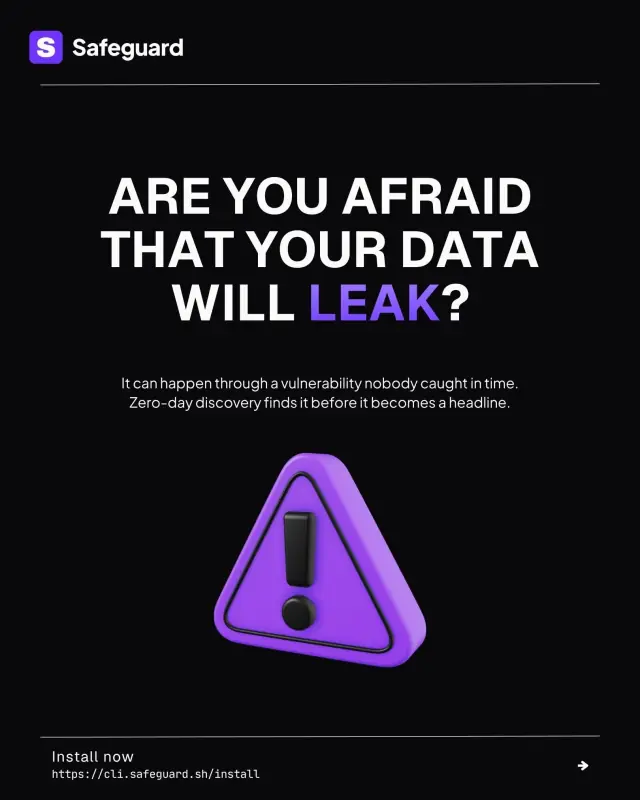
Most data doesn't leak in some dramatic hack scene. It leaks quietly, through a vulnerability nobody was watching for yet. Zero-day discovery runs its own research pipeline to catch these before they're public knowledge, so the window where you're exposed gets a lot smaller. See how it works.
 LinkedIn
Customers don't see your infrastructure. They just see whether their information stayed theirs. Catching a vulnerability before it's exploited isn't just a technical task, it's what keeps that trust intact. See how early detection protects it.
Read the full postHide the full post
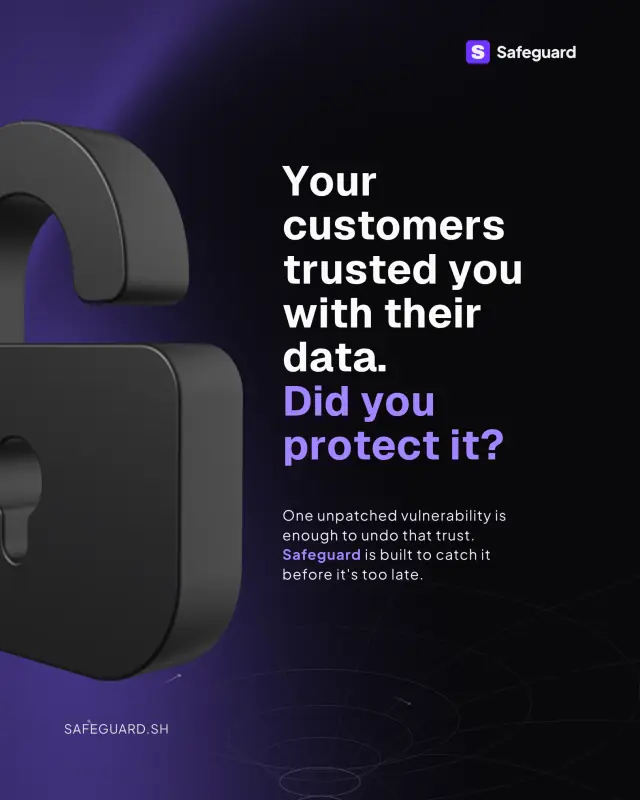
Customers don't see your infrastructure. They just see whether their information stayed theirs. Catching a vulnerability before it's exploited isn't just a technical task, it's what keeps that trust intact. See how early detection protects it.
 LinkedInVideo
Every dev team knows the feeling. The security scan comes back with thousands of issues and nobody knows where to start. Here's the thing: most of those issues sit in code your app never touches. Safeguard scans your code and dependencies, works out what's actually reachable, an…
Read the full postHide the full post
Every dev team knows the feeling. The security scan comes back with thousands of issues and nobody knows where to start. Here's the thing: most of those issues sit in code your app never touches. Safeguard scans your code and dependencies, works out what's actually reachable, and opens a tested fix for the ones that matter. Your team just reviews and merges. Less noise. Real fixes. 🔒 Link in bio to see it run on your code. #AppSec #DevSecOps #CyberSecurity #SoftwareDevelopment #DevLife #CodeSecurity #TechStartup #Developers
 LinkedInVideo
Your CVE dashboard is all green. That’s the part that should worry you. Closing every known CVE proves you handled the vulnerabilities that already have a name. A zero-day is the one that doesn’t, so it never shows up on the board you hand the auditor. When a customer’s security…
Read the full postHide the full post
Your CVE dashboard is all green. That’s the part that should worry you. Closing every known CVE proves you handled the vulnerabilities that already have a name. A zero-day is the one that doesn’t, so it never shows up on the board you hand the auditor. When a customer’s security review or a regulator asks how you handle the unknown, “we scan for CVEs” isn’t an answer. Safeguard finds zero-days before they’re public, proves which ones are actually reachable, and gives you both the fix and the evidence. Coverage complete, before the CVE exists. 30-second version below. See where you’re exposed. Book a demo.
 LinkedInVideo
Your team ships more code every week. Your scanner only knows last year’s CVEs. A scanner matches known vulnerabilities. But the one that actually hurts, the flaw an AI just wrote into your codebase, doesn’t have a CVE yet. No advisory, no signature, nothing to match. So we buil…
Read the full postHide the full post
Your team ships more code every week. Your scanner only knows last year’s CVEs. A scanner matches known vulnerabilities. But the one that actually hurts, the flaw an AI just wrote into your codebase, doesn’t have a CVE yet. No advisory, no signature, nothing to match. So we built Safeguard to find the zero-day in your own code and dependencies, prove it’s actually reachable so you’re not chasing noise, then open the tested fix as a pull request your team can review. Review it, merge it, keep shipping. 30-second version below. Want it pointed at your repo? Book a demo.
 LinkedInVideo
That notification badge you’ve been ignoring for three weeks is doing more work than you think. The scariest bugs in your software aren’t the ones with a CVE and a patch waiting. They’re the ones nobody’s named yet, quietly worth more on the open market than most engineers make…
Read the full postHide the full post
That notification badge you’ve been ignoring for three weeks is doing more work than you think. The scariest bugs in your software aren’t the ones with a CVE and a patch waiting. They’re the ones nobody’s named yet, quietly worth more on the open market than most engineers make in a decade, sitting in code someone shipped and forgot.
 LinkedInVideo
The vulnerability that gets you won’t have a CVE yet. No CVE means no patch, no advisory, and nothing for a scanner to match against. That’s a zero-day, and it’s already sitting in your dependencies. So we built Safeguard to find the flaw before the CVE exists, prove it’s actual…
Read the full postHide the full post
The vulnerability that gets you won’t have a CVE yet. No CVE means no patch, no advisory, and nothing for a scanner to match against. That’s a zero-day, and it’s already sitting in your dependencies. So we built Safeguard to find the flaw before the CVE exists, prove it’s actually reachable in your code so you’re not chasing noise, then hand your team the fix as a pull request they can review. 30-second version below. Want it pointed at your code? Book a demo: https://lnkd.in/gVHrach5
 LinkedInVideo
A CVE is a lagging indicator. By the time a flaw has a name, it’s public, and you’re patching in hindsight. Short video on the part that actually matters: finding the vulnerability before it’s named. Proving it’s reachable, so you fix what counts, not noise. Then shipping the fi…
Read the full postHide the full post
A CVE is a lagging indicator. By the time a flaw has a name, it’s public, and you’re patching in hindsight. Short video on the part that actually matters: finding the vulnerability before it’s named. Proving it’s reachable, so you fix what counts, not noise. Then shipping the fix as a pull request your team can review, not one more ticket. Same for the code your models write and the MCP servers they call. Want it pointed at your code? Book a demo.
 LinkedIn
CAPTION: Found something before it even has a CVE number? It still gets a name, an advisory, and a suggested fix attached to it. Comment "ADVISORY" and we'll show you what one looks like.
Read the full postHide the full post
CAPTION: Found something before it even has a CVE number? It still gets a name, an advisory, and a suggested fix attached to it. Comment "ADVISORY" and we'll show you what one looks like.
- LinkedIn
Finding it is only step one. After that, it gets checked, tagged, and disclosed the responsible way before it ever hits a public feed. Because discovering a vulnerability means nothing if the process after discovery puts more people at risk. Safeguard can help your team identify…
Read the full postHide the full post
Finding it is only step one. After that, it gets checked, tagged, and disclosed the responsible way before it ever hits a public feed. Because discovering a vulnerability means nothing if the process after discovery puts more people at risk. Safeguard can help your team identify and manage security findings with a process built for responsible disclosure. #safeguard
 LinkedInVideo
A long list of findings can look impressive, but what really matters is knowing which ones are actually worth fixing. Safeguard challenges findings and proposed fixes before they move forward, helping cut through the noise and give your team more confidence in what needs attenti…
Read the full postHide the full post
A long list of findings can look impressive, but what really matters is knowing which ones are actually worth fixing. Safeguard challenges findings and proposed fixes before they move forward, helping cut through the noise and give your team more confidence in what needs attention. Less noise, more actionable work. #safeguard
 LinkedInVideo
Some vulnerabilities don’t look dangerous at first. They can sit quietly in perfectly normal-looking code until the right conditions turn them into something exploitable. That’s why finding the unusual paths matters, not just checking for what we already know. #safeguard
Follow Safeguard

Self-healing security runs on Safeguard.
Your first fix PR is minutes away.
No sales call required, even your agent can complete the purchase over MCP.